
Uncategorized
MIDI Relay Trigger Board

Aug
While MIDI is widely recognised for controlling musical instruments such as synthesizers, keyboards, and drum machines, its applications extend far beyond audio. Over the years, it has been utilised to trigger lighting rigs, automate stage props, manage relays, fire solenoids, switch guitar pedals, and even control cameras and home automation systems. Recently, innovators like Look Mum No Computer have further demonstrated MIDI’s versatility by using it to power a wide range of unique inventions.
MIDI is a remarkably robust protocol that’s been around for decades, and because it’s supported by so much hardware and software, it’s an ideal interface for all kinds of maker projects. The challenge is that most MIDI interfaces are designed for making music, not controlling external hardware.
The Idea
I wanted to make a straightforward board that could take incoming MIDI notes and convert them into trigger outputs without the need for complicated programming, wiring or breadboarding. Just plug in a MIDI source and receive individual outputs whenever specific notes are played. The result is a compact MIDI Trigger Board with eight trigger outputs. Outputs A–G trigger when their corresponding note is received, while the eighth “X” wildcard triggers on any MIDI note.
I wanted the board to be flexible enough for all sorts of projects. Some ideas include:
- Triggering relay modules
- Controlling lighting effects
- Driving opto-isolated circuits
- Activating solenoids
- Switching analogue circuits
- Interactive art installations
- Home automation experiments
- Robotics projects
If it needs a simple digital trigger, MIDI can often be an elegant way of controlling it.

Keeping Things Simple
The aim wasn’t to create the most feature-packed MIDI controller, but rather something dependable that just works every time it’s powered on. The board is built around an ATmega328 microcontroller and ULN2803 driver, making it responsive and reliable without requiring any external computer once powered.
The ULN2803 outputs act as open-collector switches, allowing the board to pull an external input down to ground rather than directly supplying the output voltage
Compatibility
One unexpected discovery during development was that relay modules aren’t as standard as they first appear.
Although many use a simple 8-way header layout, the pin arrangements and trigger polarity can vary considerably between manufacturers. 5v at the start, GND at the end, or 5V and GND both at the start etc.
That led me down an interesting rabbit hole of testing different relay boards and experimenting with connector layouts to maximise compatibility. The latest version of the board has been arranged to work with many of the common header configurations, making wiring much easier.

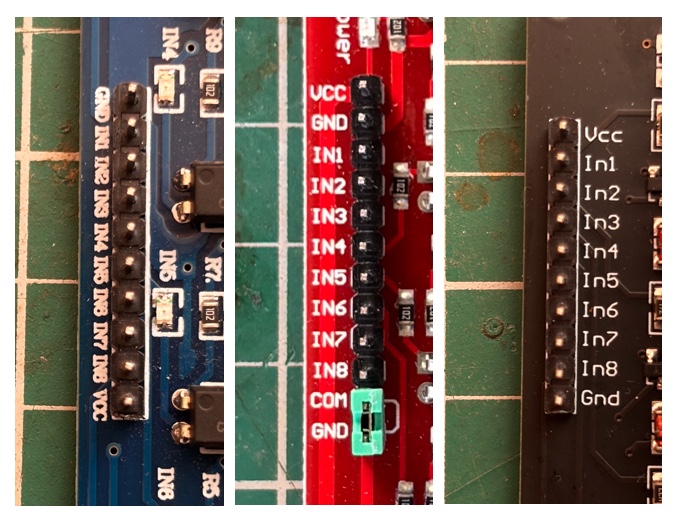
There are also 2 different types of 8-channel Relay Module on the market:
| Relay Type | Trigger Signal | Relay State |
| Active-Low | 0V / LOW | ON |
| Active-High | +5V / HIGH | ON |
The MIDI Trigger board has 2 x 12 pin headers compatible with either relay type above (only one should be used at a time).

Tested with the following ‘Active-Low’ Modules:


Tested with the following ‘Active-High’ Modules:


Specifications
- 8 x open-collector trigger outputs — ULN2803G outputs for driving active-low relay modules
- 8 x direct trigger outputs — direct ATMEGA328 outputs for driving active-high relay modules
- MIDI note-to-trigger conversion — individual triggers for notes A–G, plus an additional wildcard trigger
- MIDI Channel 1
- Standard 5-pin MIDI DIN input
- LED activity indicators — visual indication of MIDI trigger activity
- 5V power input — JST PH2.0 connector
- ATMEGA328 microcontroller
- ULN2803G Darlington transistor array
- Dimensions: 46mm × 74mm × 23mm
- Mounting holes: 4 × 2mm
Open to Experimentation
Sometimes the best projects are the simplest ones — taking an established protocol and making it easy to connect to the physical world.
That was really the idea behind this board: take something as familiar and flexible as MIDI and turn it into a set of simple, predictable trigger signals that can be connected to almost anything.
There are plenty of different ways to build something around a handful of MIDI-triggered outputs, and I’m sure there are applications I haven’t thought of yet. One person might build a MIDI-controlled relay cabinet for stage automation, while someone else uses the same board to trigger pneumatic valves, Christmas lights, or a marble machine.
If you’re looking for a simple way to turn MIDI notes into real-world trigger signals, hopefully this little board gives you a useful starting point. I’d love to hear about any cool projects you use these in! Leave a comment below and let me know.
Available to Buy
This board is available to buy in the following stores:
- The Data Point website: https://datapoint.uk/product/midi-relay-trigger-board/
- eBay: https://www.ebay.co.uk/usr/data_point_ltd
- Etsy: https://datapoint.etsy.com
- Tindie: https://www.tindie.com/stores/data_point_ltd/
- Lectronz: https://lectronz.com/stores/datapoint
